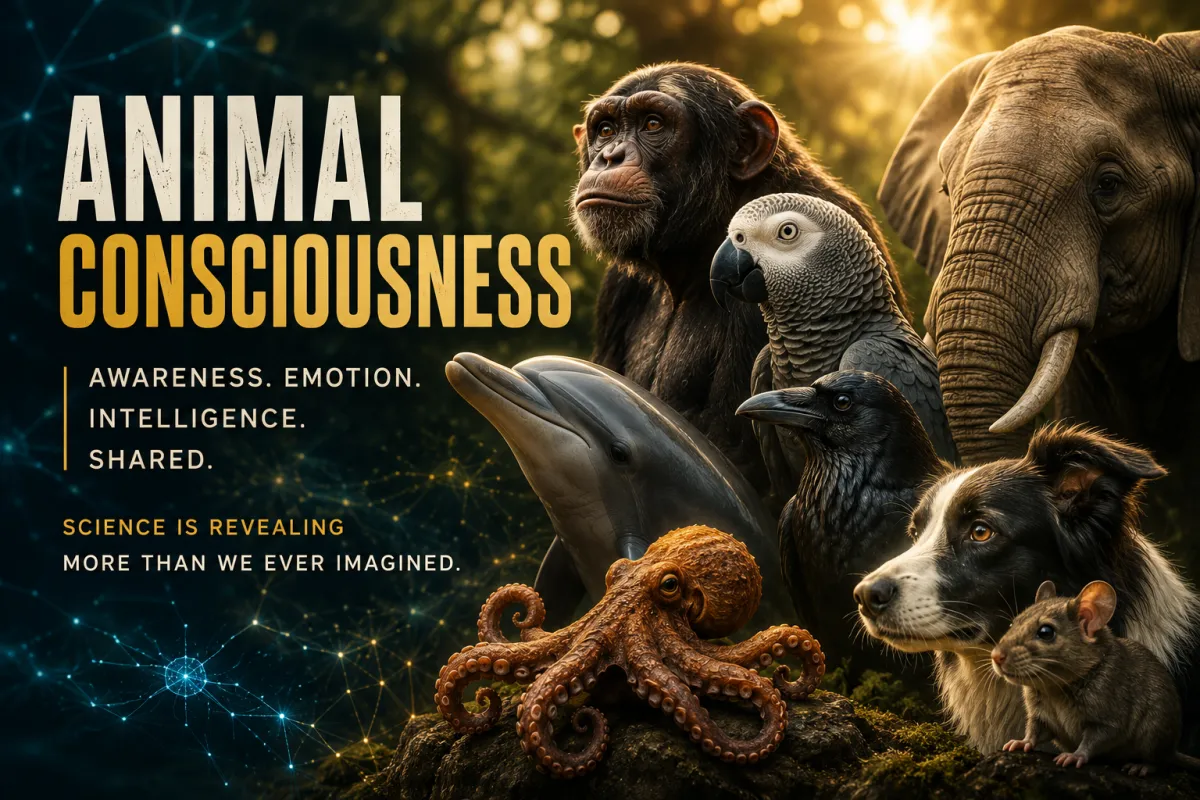
Animal Consciousness: What Kanzi, Alex, and Other Remarkable Animals Reveal About the Mind
“The more we explore the minds of other animals, the more we discover that consciousness may not separate us from nature—it may connect us to it.” — Dr. Vicki Draeger
What If Animals Are Conscious? The Science That Changes How We See the Mind
Episode [8] · [June 3, 2026] · Blossoming Brains Podcast
Introduction:
What if consciousness isn't uniquely human but a shared thread connecting minds across the animal kingdom?
For centuries, humans viewed themselves as fundamentally different from other animals. Yet modern research into animal consciousness is revealing extraordinary evidence of intelligence, emotion, self-awareness, communication, and even imagination in species ranging from bonobos and parrots to elephants, dolphins, crows, and octopuses.
In this episode of Blossoming Brains, Dr. Vicki Draeger explores the science of animal consciousness and what these discoveries teach us about learning, neuroplasticity, and our own evolving minds.
Listen on:
In this episode
How Kanzi the bonobo learned symbolic language and understood spoken English
Why Alex the African Grey parrot challenged assumptions about bird intelligence
What mirror self-recognition reveals about consciousness
How elephants, dolphins, and crows demonstrate advanced cognition
Why octopuses may experience awareness differently than humans
What animal consciousness teaches us about lifelong learning
Key takeaways
Consciousness may exist on a spectrum rather than as a human-only trait
Learning flourishes through curiosity, engagement, and social interaction
Different brain structures can support sophisticated cognition
Emotional intelligence appears throughout the animal kingdom
Studying animal minds helps us understand our own brains more deeply
Empathy and ethical responsibility grow from recognizing shared awareness
Resources mentioned
Andrews, K. (2020).The animal mind: An introduction to the philosophy of animal cognition(2nd ed.). Routledge.
Bekoff, M. (2007).The emotional lives of animals. New World Library.
de Waal, F. B. M. (2016).Are we smart enough to know how smart animals are?W. W. Norton & Company.
Gallup, G. G. (1970). Chimpanzees: Self-recognition.Science, 167(3914), 86–87.https://doi.org/10.1126/science.167.3914.86
Hare, B., Call, J., & Tomasello, M. (2001). Do chimpanzees know what conspecifics know?Animal Behaviour, 61(1), 139–151.https://doi.org/10.1006/anbe.2000.1518
Pepperberg, I. M. (1999).The Alex studies: Cognitive and communicative abilities of grey parrots. Harvard University Press.
Pepperberg, I. M. (2006). Cognitive and communicative abilities of grey parrots.Applied Animal Behaviour Science, 100(1–2), 77–86.https://doi.org/10.1016/j.applanim.2006.04.015
Savage-Rumbaugh, E. S., Shanker, S. G., & Taylor, T. J. (1998).Apes, language, and the human mind. Oxford University Press.
Low, P., Panksepp, J., Reiss, D., Edelman, D., & Van Swinderen, B. (2012). The Cambridge Declaration on Consciousness. University of Cambridge.
Marino, L. (2017). Thinking chickens: A review of cognition, emotion, and behavior in the domestic chicken.Animal Cognition, 20(2), 127–147.https://doi.org/10.1007/s10071-016-1064-4
Watch on YouTube
Episode transcript
Note: This summary was created from the episode transcript and highlights the main topics discussed.
What if consciousness isn't uniquely human?
In this episode of Blossoming Brains, Dr. Vicki Draeger explores the fascinating science of animal consciousness and the growing evidence that many animals possess forms of intelligence, emotion, self-awareness, and problem-solving once thought to be uniquely human.
Through the remarkable stories of Kanzi the bonobo and Alex the African Grey parrot, listeners discover how animals can communicate, learn symbolic language, understand abstract concepts, and even demonstrate behaviors suggesting imagination and theory of mind. The episode also examines research involving elephants, dolphins, crows, ravens, magpies, and octopuses, revealing a wide range of cognitive abilities across the animal kingdom.
Dr. Draeger discusses how these discoveries challenge traditional views of consciousness and support the idea that awareness may exist on a spectrum rather than as an exclusively human trait. The episode also connects animal cognition research to neuroscience, neuroplasticity, and lifelong learning, showing how studying other minds can deepen our understanding of our own.
Ultimately, this episode invites listeners to reconsider what it means to be conscious and to appreciate the rich mental lives of the animals with whom we share our world.
About the host
Dr. Vicki Draeger is a science educator, author, and mother of five whose work focuses on lifelong learning, neuroscience, and how the brain changes at every age. Named one of Hawaii’s top science teachers and a finalist for the U.S. Department of Energy’s Albert Einstein Distinguished Educator Fellowship, she now hosts Blossoming Brains to explore how minds—from human children to octopuses—learn, adapt, and thrive.