Brain Myth-Busters: Neuroplasticity, Aging, and Human Potential | Blossoming Brains
“The life you repeatedly practice becomes the brain you repeatedly build.”
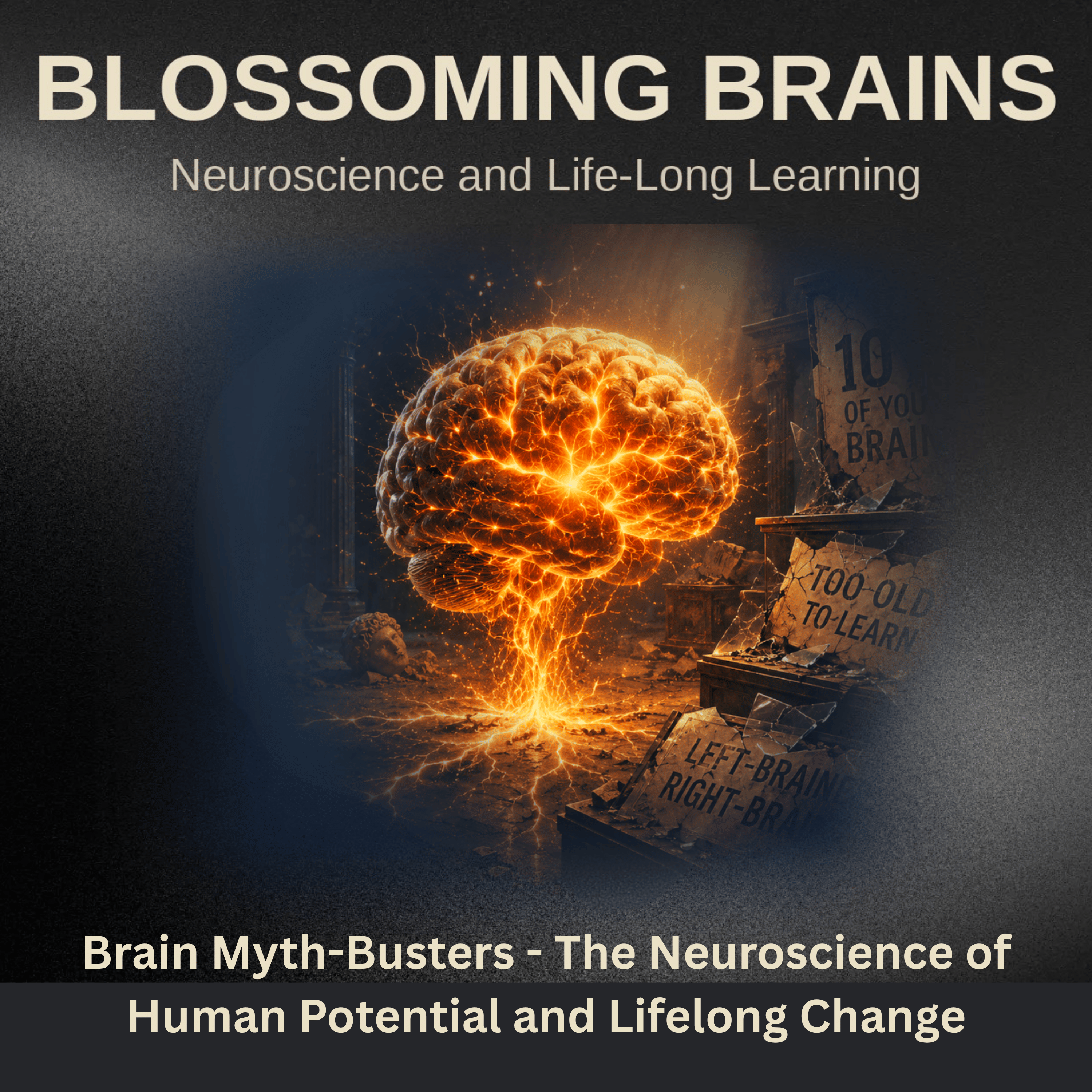
Brain Myth-Busters: The Neuroscience of Human Potential and Lifelong Change
Episode [3] · [May 9, 2026] · Blossoming Brains Podcast
Introduction:
What if the most limiting thing about your brain is what you’ve been taught to believe about it?
In this episode of Blossoming Brains, Dr. Vicki Draeger explores the neuroscience behind neuroplasticity, aging, memory, learning, and human potential while dismantling some of the most persistent myths about the brain. What emerges is not just a science lesson, but a hopeful reframing of what growth and reinvention remain possible throughout life.
This episode reveals why the brain is less like a fixed machine and more like a living ecosystem — constantly adapting itself through habits, movement, thoughts, attention, and curiosity.
Listen on:
🟢 Spotify
▶️ YouTube
In this episode
Why the “10% brain myth” continues to mislead people
The truth behind left-brain vs. right-brain thinking
How adult brains continue generating new neurons
Why memory behaves more like reconstruction than recording
The connection between novelty, dopamine, and learning
How repeated thoughts physically strengthen neural pathways
Why aging does not eliminate the brain’s capacity to change
Key takeaways
Neuroplasticity allows the brain to reshape itself throughout life
Habits and repeated thoughts physically influence brain wiring
Curiosity and novelty support motivation and memory
Exercise benefits cognitive health as well as physical health
Mature brains retain remarkable learning potential
Small intentional changes can strengthen mental flexibility over time
Resources mentioned
Do you only use 10 percent of your brain? (2010). BrainFacts.org, Society for Neuroscience.
Hogg Therapy. (2021). Beyond the 5 senses: Understanding all 8 senses (proprioception, vestibular, interoception).
Halgren, E. (2024). Do we only use 10 percent of our brain? MIT McGovern Institute for Brain Research
Misconceptions: The truth about brain usage—Debunking the 10% myth. (2023). Communicating Psychological Science
Neuroscientists debunks: We only use 10% of our brain. (2025). YouTube [Short]. Association for Psychological Science.
Science News Staff. (2007). Brain gain. Science News.
Sperry, R. W. (1968). Hemisphere de-connection and unity in conscious awareness. American Psychologist, 23(10), 723–733.
Wu, R., et al. (2019). Older adults: Daunted by learning a new task? Learn three. University of California, Riverside News.
Watch on YouTube
Episode transcript
Welcome to Blossoming Brains, where we explore the marvelous landscape between your ears — the living, learning, ever-changing organ that makes you, you.
I’m your host, Dr. Vicki Draeger. I’m a mother of five, and for more than 30 years I’ve had the extraordinary privilege of teaching science, from the wide-eyed wonder of preschoolers to the curious drive of graduate students.
Along the way, I’ve become convinced that understanding how our brains actually work isn’t just fascinating — it’s transformational. Because when you understand how your brain learns, you can grow it for life.
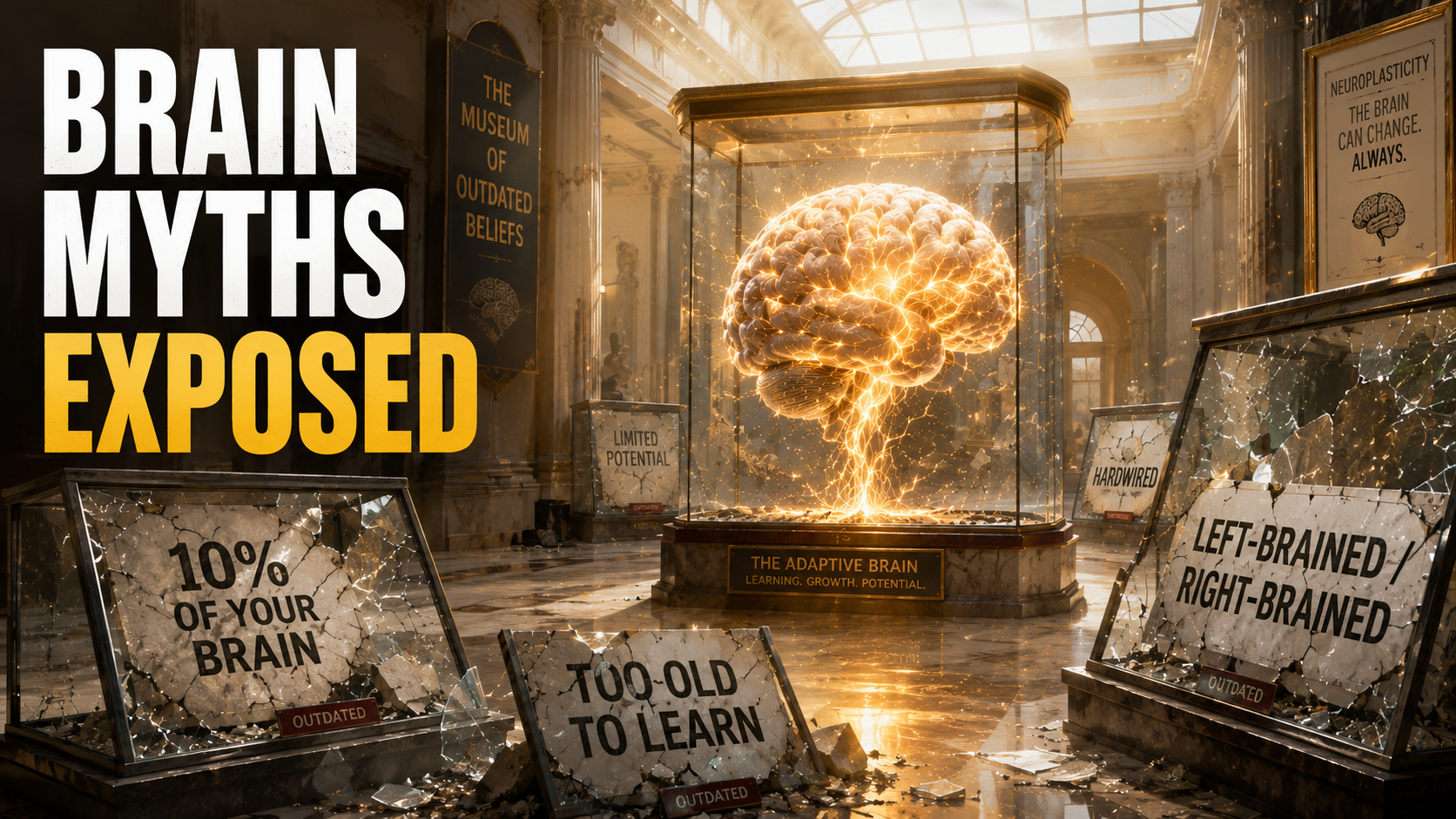
So imagine standing in a museum of myths about the human brain: ancient rumors, pop psychology, movie clichés — all dusted off and displayed like artifacts from a time when we were still guessing at the brain’s mysteries.
Some of those myths are charming. Others have quietly held us back from reaching our potential.
Today, we’re wandering through that museum together, my curious friends, to bust a few of the biggest misconceptions about how our brains work. And by the end, I want you to walk away not just a myth-buster yourself, but with a few tangible steps to help your brain stay healthy, flexible, and eager to learn for the rest of your life.
Let’s start with one of the heaviest skeletons in the museum’s closet — a myth that refuses to die no matter how many neuroscientists roll their eyes.
If I had a dollar for every time a movie narrator dramatically whispered this line, I could probably fund my own neuroscience lab.
The myth is this:
“We only use 10% of our brains.”
The idea sounds tantalizing, doesn’t it? As if there’s a secret vault of untapped genius waiting to be unlocked.
But there is no hidden chamber of unused brilliance waiting for the right motivational quote to magically activate it.
Here’s the truth:
You are using virtually all of your brain all of the time.
Even as you listen to this podcast, your auditory cortex is decoding sound waves. Your frontal lobes are analyzing meaning. Your occipital lobe is forming mental imagery from the ideas I describe. Your cerebellum is helping you balance if you’re walking, driving, or moving.
The brain is less like a dark building with locked rooms and more like a city alive at night. Some neighborhoods glow brighter depending on the activity, but power hums throughout the entire system.
Functional MRI studies from institutions like the University of Oxford consistently show that even simple activities — reading a word, sipping coffee, listening to music — activate wide networks across both hemispheres of the brain.
Nothing is sitting idly by.
So why does this myth survive?
Probably because it tells a flattering story. We like the idea of hidden potential waiting to be unlocked.
But the real magic isn’t hidden unused capacity. It’s the remarkable ability of the brain to strengthen connections through learning, curiosity, repetition, and experience.
You don’t need secret access to your brain’s power.
You need deliberate practice.
The 10% myth doesn’t reveal hidden genius. It actually undersells the brilliance already buzzing inside your head.
Now let’s move to another crowd favorite: the idea that people are either “left-brained” or “right-brained.”
You’ve probably seen the T-shirts. Maybe you’ve taken the quizzes. Maybe someone told you in school that you were “creative” because you’re right-brained or “logical” because you’re left-brained.
But neuroscience tells a much more interesting story.
Yes, certain functions tend to lean more heavily toward one hemisphere. Language often involves left-sided specialization. Spatial awareness tends to involve more right-sided processing.
But your hemispheres are constantly communicating.
If the brain were a duet, the melody and harmony would switch back and forth dozens of times every second.
Think about cooking dinner.
Your left hemisphere may help you follow the recipe, sequence steps, and calculate measurements. Meanwhile, your right hemisphere helps visualize the finished dish, judge colors and textures, and recognize your partner’s expression when they taste it.
You can’t make spaghetti with only one side of your brain participating.
Early split-brain studies by neuroscientist Roger Sperry revealed important hemispheric specialization, but later imaging studies showed something equally important: the brain rapidly recruits both sides for complex real-world tasks.
Creativity and logic are not divorced neighbors.
They are collaborative partners.
When we reduce ourselves to “left-brained” or “right-brained” people, we underestimate the cooperative genius that makes us whole.
A better question isn’t:
“Which side of my brain do I use?”
A better question is:
“How can I help my whole brain collaborate more effectively?”
Now let’s tackle another myth — one that sounds especially grim:
“Brain cells can’t regenerate.”
For decades, scientists believed that once neurons died, they were gone forever. The brain was viewed like a tree that stopped growing new branches after childhood.
But in the late 1990s, researchers like Elizabeth Gould and Fred Gage overturned that assumption with evidence of neurogenesis — the birth of new neurons in adult brains.
In regions like the hippocampus, which is deeply involved in memory and learning, new neurons continue forming throughout life.
That discovery changed neuroscience forever.
It’s like discovering that an old forest still sprouts fresh saplings every spring.
And just like a forest, growth depends on environment.
Stress, isolation, chronic sleep deprivation, and lack of novelty can suppress healthy brain growth. But movement, curiosity, learning, social connection, and exercise help nourish it.
One famous study from the Salk Institute found that mice who regularly ran on exercise wheels developed significantly more hippocampal neurons than sedentary mice.
Movement literally helped grow memory centers.
Humans show similar patterns.
A brisk walk isn’t just exercise for your muscles.
It’s fertilizer for your brain.
So when someone says:
“You can’t teach an old dog new tricks,”
they’re not just being pessimistic.
They’re scientifically wrong.
Your brain remains capable of growth as long as you remain engaged with life.
Now here’s another myth worth busting:
“The brain works like a camera.”
Wouldn’t that be convenient?
If memories were perfect recordings, life would certainly feel simpler.
But memory is not playback.
Memory is reconstruction.
Each time you remember something, your brain rebuilds the memory from pieces distributed across different regions of the cortex — sensory details, emotions, context, sounds, impressions.
It’s less like replaying a movie and more like reconstructing a puzzle.
Most of the pieces fit.
But sometimes details shift.
Psychologist Elizabeth Loftus famously demonstrated how easily human memory can be altered through suggestion and misinformation. In some cases, people can even develop vivid false memories.
This doesn’t mean your brain is broken.
It means your brain is adaptive.
The brain evolved not merely to archive information, but to help us interpret experience, predict the future, and navigate changing environments.
Your hippocampus, amygdala, and prefrontal cortex constantly collaborate to reshape memories in light of new information and emotional meaning.
That flexibility helps us learn, empathize, imagine, and grow.
So the next time you and a sibling remember a childhood event differently, don’t assume one of you is lying.
Your brains simply edited the same scene in slightly different ways.
Memory is more museum exhibit than photograph.
Curated.
Rearranged.
Sometimes repainted.
But still meaningful.
Now let’s move to another common misconception:
“We only have five senses.”
Most of us learned the classic five in kindergarten:
Sight.
Hearing.
Touch.
Taste.
Smell.
But neuroscience paints a much richer picture.
Scientists now recognize many additional sensory systems.
You have a vestibular sense that helps maintain balance.
You have proprioception — your internal awareness of where your body parts are in space.
That’s why you can reach for a coffee cup without staring directly at your hand.
You also have systems for temperature, pain, internal motion, hunger, heartbeat awareness, and time perception.
Your brain is constantly integrating all of this information into a seamless experience of reality.
Imagine the brain as a symphony conductor.
Vision may play the violins.
Hearing may carry the brass.
But underneath are the deeper instruments:
The cellos of proprioception.
The flutes of temperature.
The percussion of gut sensations and internal awareness.
Without those quieter systems, reality would feel fragmented and disorienting.
When you practice balance exercises, mindfulness, deep breathing, or intentional movement, you’re tuning these sensory systems with greater precision.
Now let’s talk about one of the most important myths of all:
“The brain is hardwired.”
This myth suggests that our mental wiring is fixed — like electrical circuits sealed behind drywall.
But neuroscience tells a profoundly different story.
Your brain is not static.
It is adaptive.
It is responsive.
It is constantly changing itself in response to experience.
This process is called neuroplasticity.
And it continues throughout life.
Every new experience strengthens, weakens, reshapes, or reorganizes neural pathways.
The brain is less like a machine and more like a living garden.
With every repeated thought, emotion, movement, and behavior, neural pathways become more deeply established.
Researchers studying London taxi drivers discovered enlarged hippocampi in drivers who spent years memorizing the city’s complex streets and routes.
Violinists show expanded sensory regions connected to the fingers they use most intensely.
The brain literally reshapes itself according to how it is used.
Habits sculpt biology.
Let me say that again:
Habits sculpt biology.
Every repeated thought deepens a pathway.
Helpful thoughts strengthen helpful pathways.
Destructive thoughts strengthen destructive pathways.
That’s why repeated mental patterns matter so much.
In many ways, the old wisdom about “taking your thoughts captive” aligns remarkably well with what neuroscience now understands about repetition and neural reinforcement.
Your internal landscape grows where your attention flows.
And that means your daily habits are not just routines.
They are acts of brain construction.
Now before we continue, I want to ask your brain to do three very small things that make a big difference:
Follow this podcast.
Like this episode.
And subscribe.
When you follow and subscribe, your app remembers Blossoming Brains and reminds you when new episodes arrive.
When you like an episode, it helps more curious minds discover it too.
So for your beautiful, busy brain:
Follow.
Like.
Subscribe.
Now let’s tackle another myth — and honestly, this one may be one of the most harmful:
“Older brains can’t learn.”
This myth quietly steals possibility from millions of people.
Many adults assume that learning new skills, languages, technologies, or creative abilities becomes impossible after a certain age.
But neuroscience says otherwise.
Yes, younger brains often absorb novelty rapidly.
But mature brains bring something powerful to learning:
Pattern recognition.
Perspective.
Emotional regulation.
Wisdom.
Experience.
Learning changes with age.
But it does not disappear.
Research from the University of California found that older adults who engaged in challenging new learning experiences — photography, quilting, digital design, and other demanding skills — improved cognitive flexibility and memory compared to adults who remained in passive routines.
Scientists sometimes call this “effortful learning.”
It requires intention.
It may take longer.
But it strengthens communication between brain regions and helps preserve cognitive vitality.
Think of the mature brain not as a dying battery, but as a seasoned athlete.
A teenager’s brain may sprint faster.
But an older brain can often run farther with strategy, resilience, and endurance.
Both forms of learning are valuable.
So let’s step back for a moment.
When you look at all of these myths together, a pattern emerges.
For generations, we underestimated the brain.
We treated it like a fixed machine running mysterious software.
But the truth is far more hopeful.
Your brain is dynamic.
Responsive.
Alive.
It listens constantly to what you repeatedly practice, believe, notice, and experience.
It thrives on movement.
Novelty.
Sleep.
Conversation.
Curiosity.
Challenge.
Consistency.
The brain is less like a robot and more like a rainforest — constantly adapting and reorganizing itself.
And that brings us to this week’s brain-friendly habit.
I want you to do one small thing that surprises your neurons.
Brush your teeth with your non-dominant hand.
Take a different route on your walk.
Learn a few words in another language.
Listen to music you would normally skip.
Try something unfamiliar.
Novelty disrupts predictable neural patterns and helps stimulate new connections.
Researchers at Duke University found that novelty activates dopamine systems tied to learning, memory, and motivation.
In simple terms:
Your brain loves surprise because surprise signals opportunity.
So be curious on purpose.
Because your brain is not a warehouse of forgotten potential.
It is a living playground that remodels itself every day you use it.
And once you understand that, limitation starts to look a lot more like another myth waiting to be busted.
Thank you for listening to Blossoming Brains.
If you enjoyed this episode, share it with another curious mind who might need this reminder.
And if you try the novelty challenge this week, I’d love to hear how it goes.
Because the more we understand our brains, the better we can guide them — not with superstition or limiting beliefs, but with science, intention, and a healthy dose of wonder.
Until next week:
Keep learning.
Keep growing.
And keep blossoming.
About the host
Dr. Vicki Draeger is a science educator, author, and mother of five whose work focuses on lifelong learning, neuroscience, and how the brain changes at every age. Named one of Hawaii’s top science teachers and a finalist for the U.S. Department of Energy’s Albert Einstein Distinguished Educator Fellowship, she now hosts Blossoming Brains to explore how minds—from human children to octopuses—learn, adapt, and thrive.