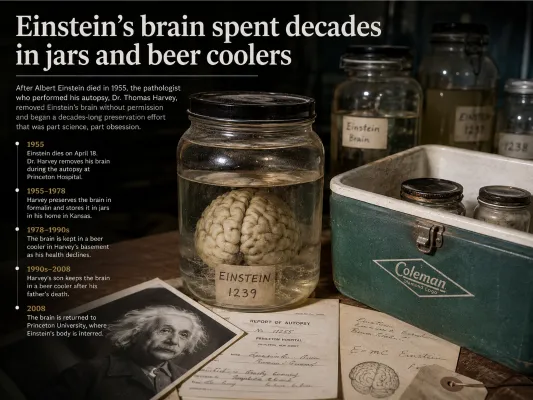
Einstein’s Brain: The Strange Story Behind Genius and Neuroplasticity
“The most famous brain in history was stolen before the body was even cremated.”
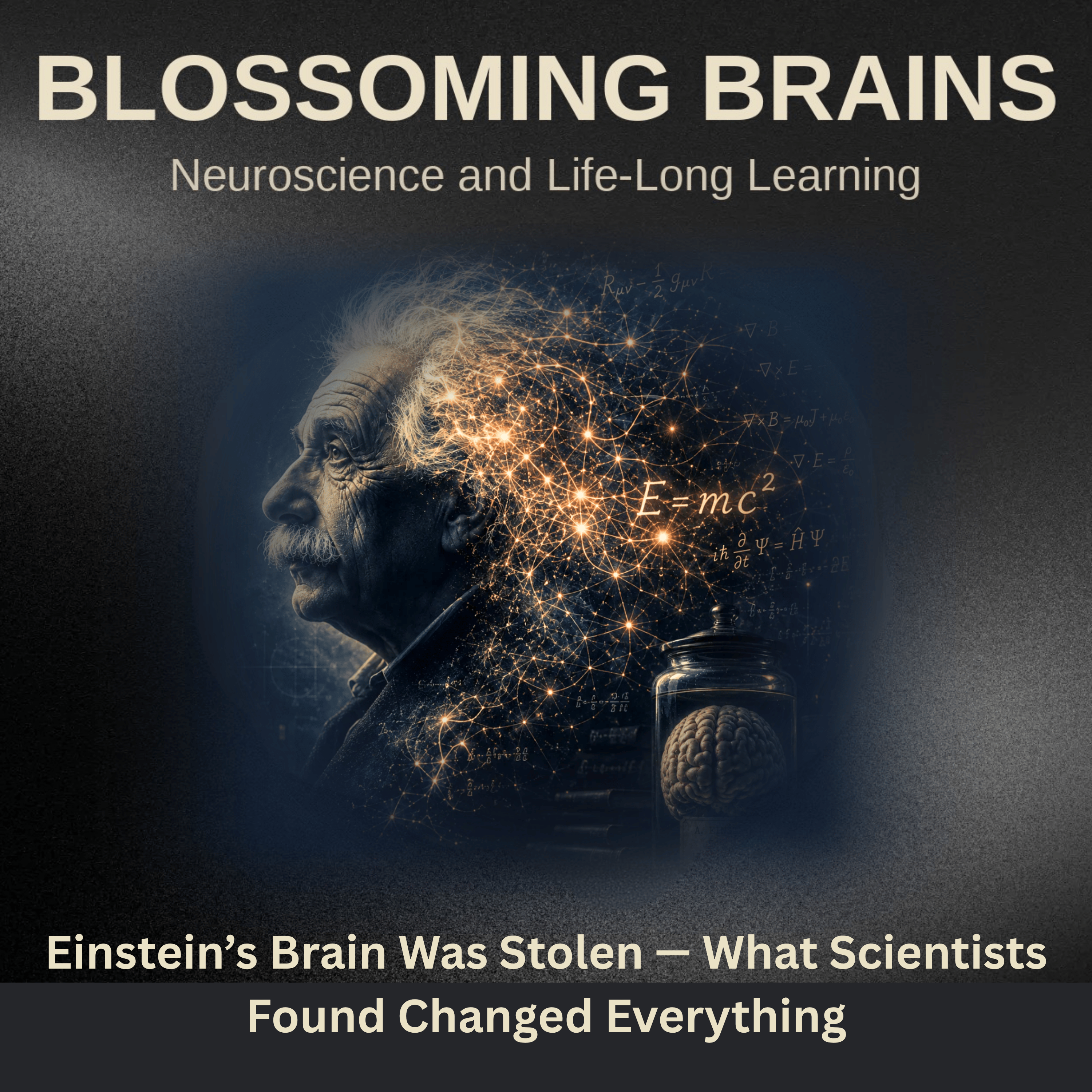
Einstein’s Brain: The Strange Story Behind Genius and Neuroplasticity
Episode [2] · [May 7, 2026] · Blossoming Brains Podcast
Introduction:
Einstein’s brain was stolen after his death, but the real mystery is what it revealed about genius, neuroplasticity, and lifelong learning.
In this episode of Blossoming Brains, Dr. Vicki Draeger explores the bizarre true story of what happened after Albert Einstein died in 1955, when pathologist Thomas Harvey secretly removed Einstein’s brain during the autopsy and kept it for decades. But beneath the strange history lies a fascinating scientific question: what actually creates genius?
The episode examines Einstein’s life, the neurological discoveries researchers eventually uncovered, and the growing evidence that curiosity, imagination, and deep learning may physically reshape the human brain over time.
Listen on:
🟢 Spotify
▶️ YouTube
In this episode
The shocking story of how Einstein’s brain was removed without permission
Why Thomas Harvey kept the brain for more than 40 years
What scientists actually discovered inside Einstein’s brain
Why Einstein’s brain size surprised researchers
The role glial cells may play in intelligence and learning
How neuroplasticity may help explain genius itself
Key takeaways
Genius is not simply about brain size
Curiosity and lifelong learning may physically shape the brain
Einstein’s cognitive style was unusually visual and imaginative
Neuroplasticity continues throughout life
The science of genius is more human and accessible than many people assume
The ethical questions surrounding Einstein’s brain remain deeply controversial
Resources mentioned
Diamond, M. C., Scheibel, A. B., Murphy, G. M., Jr., & Harvey, T. (1985). On the brain of a scientist: Albert Einstein. Experimental Neurology, 88(1), 198–204.
Falk, D., Lepore, F. E., & Noe, A. (2013). The cerebral cortex of Albert Einstein: A description and preliminary analysis of unpublished photographs. Brain, 136(4), 1304–1327.
Hamilton, A. (1999, June 28). Was Einstein’s brain built for brilliance? Time.
Hirsch, E. (1992). The human frontal lobes and frontal lobe syndromes. In S. P. Wise (Ed.), Frontal lobe function and dysfunction (pp. 3–21). Oxford University Press.
Koren, M., & Paterniti, M. (1997, September). Driving Mr. Albert. Harper’s Magazine, 295(1770), 35–44.
Paterniti, M. (2000). Driving Mr. Albert: A trip across America with Einstein’s brain. Dial Press.
Paterniti, M. (2014, April 18). The long, strange journey of Einstein’s brain. BBC News Magazine
Teresi, D., & Olson, S. (2000). The strange case of Dr. Harvey and the brain of Albert Einstein. In D. Teresi, Lost discoveries: The ancient roots of modern science (pp. 291–306). Simon & Schuster.
Tytell, J. (1991). William S. Burroughs: A biography. Grove Weidenfeld.
Whitman, H. W. C. (2006). Dr. Henry Cattell’s private confession about what happened to Whitman’s brain. Walt Whitman Quarterly Review, 23(4), 203–210.
Watch on YouTube
Episode transcript
Okay, picture this. It's April 18th, 1955. A family grieves. A hastily called press conference is already underway downstairs. And the man who possessed the greatest scientific mind of the 20th century has just taken his last breath in a quiet hospital room in Princeton, New Jersey. The family's wishes are clear, cremate the body, scatter the ashes privately.. No fuss. No fanfare, exactly as the dead man had requested. Albert Einstein wanted to vanish into the universe he had spent his life decoding. However, one man has a different idea. Dr. Thomas Harvey removes Einstein's brain during the autopsy, physically extracting the brain from Einstein's skull himself.
This is not a case of opportunistically taking an already removed organ. Rather, Harvey performs the cranial dissection as the attending pathologist, which gives him both the means and the moment to act. And act, he does. He puts Einstein's brain into a jar and then he takes it home. His wife screams when she sees it's sitting on her kitchen table and that brain
will spend the next half century riding around in the trunks of cars, hiding in cardboard boxes, sitting in beer coolers in Kansas basements, getting mailed around the world in paper parcels, all while the man who took it watches his career, his marriages and his reputation slowly unravel around him.
This is not science fiction. This is one of the strangest true stories in the history of neuroscience. And by the end of today's episode, you'll understand not just what made Einstein's brain unusual, but what that might tell us about all of our own brains. So welcome to Blossoming Brains. I'm your host, Dr. Vicki Draeger. I'm a mother of five, and for more than 30 years I've had the extraordinary privilege of teaching science from the wide-eyed wonder of preschoolers to the curious drive of graduate students. Along the way, I've become convinced that understanding how our brains actually work isn't just fascinating, its transformational because when you understand how your brain learns, you can grow it for life. And today we're going to look at the most famous brain in human history. We're going to talk about the man that it belonged to and the man who stole it, the science that eventually came from it, and the profound and honestly humbling question it leaves us all with. What is genius, really, and can we grow it? Let's start at the beginning. Who was Albert Einstein? Albert Einstein. Even saying the name feels like a shortcut, a one word synonym for genius, but let's take a moment to really appreciate why. Born in Ulm Germany in 1879 Einstein was not as legends sometimes has it, a terrible student.
He was actually excellent in math and physics, though he did chafe against rote memorization and rigid authority, which as a Montessori trained teacher myself, I find entirely understandable. He had a stubborn independence of mind that it turns out would change everything. In 1905, when he was just 26 years old and working as a lowly patent clerk in Bern Switzerland, Einstein published four scientific papers that would reshape our entire understanding of reality.
Not one paper, four in one year. Scientists call it his “annus mirabilis,” his Miracle Year. One of those papers introduced the special theory of relativity. Another gave us the equation, E equals mc squared. That's energy equals mass times the speed of light squared, the most famous equation in history, which essentially told us that mass and energy are two sides of the same cosmic coin.
In fact, mass is just frozen energy. Think about what that means. Before Einstein, we thought space was space and time was time... fixed, fixed, separate, absolute. Einstein said no. Space and time are woven together into a single fabric space time, and that fabric bends and stretches depending on gravity and speed.
If you've ever used GPS navigation, by the way, those satellites have to account for Einsteinian relativity to give you accurate directions. So the next time your phone routes you around a traffic jam, you can quietly thank Albert. He won the Nobel Prize in physics in 1921 and became arguably the most recognizable human being on the planet, A global celebrity in an era before social media, before television was even widespread.
People mobbed him wherever he went. He corresponded with world leaders. He wrote poetry. He played the violin, and he advocated passionately for civil rights and pacifism. He was also by all accounts, wonderfully eccentric. He rarely wore socks. He picked up cigarette butts off the ground and harvested the leftover tobacco for his pipe.
He insisted that smoking helped him think more clearly, which for the record, neuroscience does not support. He once said imagination is more important than knowledge. He said the measure of intelligence is the ability to change. He was in short, exactly the kind of lifelong learner this podcast celebrates.
By the time Einstein landed in Princeton, New Jersey in 1933, fleeing the rise of Hitler's Germany, since he was Jewish, he had already become a living legend. He would spend the rest of his life at the Institute for Advanced Study there, walking across campus thinking, writing, occasionally getting lost and scribbling equations on anything he could find.
By April of 1955, Einstein was 76 years old. He had a long standing abdominal aortic aneurysm. Essentially, it's a dangerous bulge in the main artery of his body, and his doctors knew it could erupt at any time. Einstein knew it too, and in that characteristic unsentimental way of his, he was at peace with it.
He reportedly told his doctors, I want to go when I want to go. It is tasteless to prolong life artificially. I've done my share. It is time to go. He spent one of his last days working at his desk drafting a speech for Israeli Independence Day. Then the aneurysm burst. He was taken to Princeton Hospital and in the early hours of April 18th, 1955, he muttered a few words in German, word his nurse didn't speak and then he was gone. Now, here is where the story gets strange. Downstairs the hospital was holding a press conference. Reporters were everywhere. And while all of that was happening, the pathologist on duty, a Yale trained doctor named Thomas Stoltz Harvey was performing the routine autopsy.
He determined the official cause of death, the ruptured aneurysm, and then he did something that was decidedly not routine. He removed Einstein's brain. Medical and legal norms state the tissue removed in an autopsy is not the personal property of the pathologist. Harvey had no recognized right to keep it for himself.
However, in fairness to Harvey, the idea of preserving and studying the brains of great thinkers was not entirely unusual for that era. It had actually been a bit of a hobby, let's say, among 19th and early 20th century scientists. Instead of collecting coins or stamps, the American Anthropometric Society and similar Brain Clubs collected human brains.
They believed that studying the brains of eminent people might reveal the physical basis of genius and character. Walt Whitman, an American poet, essayist and journalist, whose innovative free verse in his famous poems, Leaves of Grass and his civil war writings made him one of the most influential figures in American literature.
He allowed his brain to be preserved for study. Then a lab assistant dropped it on the floor and smashed it. That's a true story. So there was a certain scientific tradition, of brain collecting that Harvey was following. The issue was that he had no permission from Einstein or his family at the time
he took off with the brain. The problem is simply this. Einstein had left explicit instructions, cremate me, scatter my ashes privately. Do not let me become a relic or an idol. He was famously a man who hated celebrity worship, and yet Harvey, without asking anyone, without any permission from the family, removed the brain, photographed it, and took it home.
The body was cremated that same day. The ashes were scattered in a secret location as Einstein had requested, and the family had no idea that someone had absconded with the brain. They found out the next morning from the newspaper. I want you to imagine Einstein's son, Hans Albert, reading the paper over breakfast and seeing a headline about his father's brain having been removed for scientific study.
Hans Albert was understandably furious. He confronted Harvey directly and Harvey, who was apparently a very persuasive man, talked his way into permission. He convinced Hans Albert that the brain would be studied rigorously, scientifically, respectfully, and that any findings would be published purely in the interest of science.
No sensationalism, no circus to this. I can only say liar, liar, pants on fire. However, Hans Albert reluctantly agreed. Within days, Harvey lost his job at Princeton Hospital, almost certainly because of the brain incident, and so he packed up his two mason jars, he'd already sliced the brain into approximately 240 pieces and preserved them and began what would become one of the most bizarre odyssey in the history of medicine.
What happened next is the kind of story that makes you wonder whether truth is in fact, stranger than fiction. Harvey moved to Philadelphia, then to the Midwest. He took a job as a medical supervisor in a biological testing lab in Wichita, Kansas, Einstein's brain, the brain that had conceived relativity, that had bent the laws of physics
was stored in a cider box inside a beer cooler in the corner of his office. Think about that image for a moment. The most celebrated brain in human history, beer cooler, Kansas. Years passed.. Harvey kept sending small chunks of brain to researchers mailing them around the country, sometimes even around the world in little labeled parcels.
But he himself published nothing. The family was growing suspicious. Journalists were sniffing around, and the scientific community, for the most part, was not exactly clamoring to study it. There was real controversy about the ethics of how the brain had been obtained. Harvey stored brain specimens in jars in his home basement when his marriage deteriorated amid rumors of affairs and job loss. His wife grew frustrated and threatened to throw the brain out, seeing it as a burden. Harvey returned in time to retrieve it and then relocated to the Midwest, to Kansas and to Missouri with the brain in tow. He lost his medical license in 1988, after failing a three day competency exam. He worked night shifts at a plastics factory.
Harvey moved into a cramped apartment next to a gas station. His neighbor was a beat poet named William Burrows. Burrows previously had accidentally shot and killed his wife, Joan Volmer during a drunken William Tell stunt when he was attempting to shoot a glass off her head with a pistol with instead struck her forehead.
Burrows apparently loved to boast to visitors that he could get a piece of Einstein anytime he wanted. I genuinely could not make this up. In 1998, Harvey then in his eighties road-tripped across the country with a journalist named Michael Paterniti, with Einstein's brain riding along in the trunk in a Tupperware container.
They drove to California to visit Einstein's granddaughter, Evelyn. Paterniti wrote a book about their journey called Driving Mr. Albert, and it is exactly as surreal as it sounds. During the road trip in Driving Mr. Albert,the 84-year-old Harvey is depicted as chaotic with a booming voice, protruding eyes, mischievous smiles, and an odd habit of laughing at inappropriate moments,
often fixating on historical trivia or personal regrets. Finally, that same year, Harvey returned the remaining uncut portion of the brain to a pathologist at Princeton University Medical Center, the very same hospital where Einstein had died 43 years earlier. The brain had come home. Harvey died in 2007 at the age of 94. He passed away of all places in the same hospital where he had performed Einstein's autopsy 52 years before. So the question now is, what did science actually find? That's the question we've all been waiting for after all of that 50 years of beer coolers and cardboard boxes and road trips in Tupperware.
What did scientists actually find when they studied Einstein's brain? The answer is fascinating, nuanced, and honestly a little humbling. Let me walk you through the key findings. First, let's dispense with the obvious assumption. Einstein's brain was not large. At 1,230 grams just under three pounds, it was well within the normal human range and actually slightly smaller than average.
So if you've ever had the secret fantasy that genius correlates with brain size, science is here to disappoint you. Size, it turns out is not the thing. So here's where it does get rather interesting. In 1985, 30 years after Einstein's death, a neuroscientist at UC Berkeley named Marion Diamond, published the first formal study of Einstein's Brain Diamond was a pioneer in the field of neuroplasticity
the idea that our brains physically change in response to experience and learning. She was, in many ways, a kindred spirit to what we talk about on this podcast, and you're going to hear about neuroplasticity a lot. Diamond found that in certain regions of Einstein's brain, particularly in an area of the left parietal lobe, associated with mathematical reasoning and spatial thinking
there was a significantly higher ratio of what are called glial cells relative to neurons than in the average brain. Now, let me translate that because it's important. Neurons are what we always think about as the brain cells, and they are the famous thinking cells, the one that fire electronic signals.
But glial cells were long considered, little more than brains support staff. The scaffolding, the janitors, they were thought to just hold everything together and clean up the mess. Diamond's findings suggested something more interesting, that Einstein's neurons in those key regions had a richer, more supportive environment.
So to understand that a little better, imagine a brilliant musician performing in Carnegie Hall versus performing in a garage band. May have even the same talent, but vastly different support infrastructure. Glial cells we now know actually play active roles in neural communication, metabolism, and even learning.
The support staff turns out to be far more important than we once thought. As a small but important footnote, please take note of this. Diamond's study had some methodological limitations. The control group was slightly younger than Einstein, and cell counting is a subjective process. Science is honest about these things, or at least it should be.
But the finding was still meaningful enough to generate decades of follow-up research. In 1999, researchers at McMaster University published a study comparing photographs of Einstein's brain with standard brain atlases. Harvey had taken extensive photos at the time of the autopsy. They found that Einstein's parietal lobes were approximately 15% wider than average, and that a region called the inferior parietal lobule was unusually well-developed.
This area is associated with mathematical reasoning, spatial visualization, and the ability to think in three dimensions. It's the part of your brain that helps you mentally rotate objects, understand how things fit together in space, and apparently like Einstein imagined what it would look like to someone riding a stride, a beam of light.
That was the imagination that led him to his theory of relativity. He thought to himself, Hmm, I wonder what things would look like to someone riding astride a beam of light. Interestingly, they found that a groove called the Sylvian Fissure was shorter in Einstein's brain than usual, which may have allowed the parietal regions,
those parietal regions are the ones up here. Remember from our podcast on the lobes of the brain, you have the temporal and you have the frontal, and then you have the parietal up here, okay? Which may have allowed the parietal regions to be more directly connected to each other. So you might think of it as fewer traffic lights on the highway between two busy cities.
So you could have faster communication, more efficient integration of ideas. And then in 2012, there was a study that was led by Dean Falk at Florida State University. And he conducted a more exhaustive analysis of Harvey's original autopsy photographs, and they found an extra bridge, an additional fold on Einstein's prefrontal cortex, the region that's associated with planning, working, memory, and complex decision making.
They also noted unusual complexity in the patterns of his motor cortex, particularly in the areas that control the face and tongue, which some researchers linked to the way Einstein himself said he often thought. This is kind of unusual. Einstein said that when he thought, he thought, not in words, but in physical sensations and muscular feelings.
I'm not sure I understand what that would even look like, but obviously I don't have Einstein's brain. So no groundbreaking new empirical findings have emerged in 2025 or 26, but researchers have proposed advanced techniques for future analysis. Einstein once wrote that his thinking occurred as a kind of wordless visual and muscular thinking, as I said before.
I want to ask your brain to do three small things that make a big difference. Follow this podcast, like this episode, and subscribe. When you follow, like, and subscribe, your app saves Blossoming Brains for you and reminds you when new episodes come out. Follow so you can find the podcast again. Like so the apps know this episode was valuable.
Subscribe so your brain gets a gentle reminder to keep growing with us. So one more time, for your beautiful busy brain, follow the podcast, like this episode, and subscribe to Blossoming Brains wherever you're listening or watching
So the physical structure of his brain may have literally supported that mode of cognition. And I don't know anyone else that has that mode of cognition, although perhaps there are such people. Now, I want to be honest with you because that's again what science demands. Despite all of these findings, we have not unlocked the secret formula for genius.
Brain shape varies from person to person. Some of what we see in Einstein's brain may simply be natural variation. We'd need to study hundreds of other brilliant minds to really establish what's signal versus just noise. And perhaps most importantly, did Einstein's brain look the way it did because he was born that way?
Or did it look that way because of how he used it? The decades of concentrated, curious, imaginative thinking, might that have shaped his brain? That question is at the very heart of what we explore on blossoming brains because neuroplasticity, the brain's ability to physically reshape itself in response to experience suggests the answer could be both.
Nature gave him a starting point, but nurture and a relentless lifelong love of learning may have built it. So where is Einstein's brain today? The largest remaining portion is housed at the University Medical Center of Princeton. The same hospital where Einstein died, where Harvey performed the autopsy, and where Harvey himself died decades later.
It's not on public display. It lives in the collections of the pathology department accessible to researchers. 46 thin sections of Einstein's brain microscopic slides mounted and stained are on display at the Muer Museum in Philadelphia, one of America's great medical oddity museums. If you're ever in Philly and you want to see history under glass, that's where to go.
Some smaller pieces are almost certainly still scattered around the world, in the labs and personal collections of researchers who received them. A Japanese professor was handed a piece of the brainstem in a 1994 documentary right on camera. Some may be family keepsakes. A few are simply unaccounted for.
And then there's this wonderful, absurd footnote. A piece of Einstein's brain was apparently smuggled into Canada in a cookie jar during one of Harvey's road trips. I choose to believe Einstein would've found all of this extremely funny. Now, you might be wondering, did Dr. Harvey ever get into serious legal trouble for taking the brain without permission?
The short answer is not in the way you might expect. As I said before, in 1955, the laws around autopsy and the retention of tissue samples were far more ambiguous than they are today. Harvey was operating in a legal gray area and he knew it, but he was fired from Princeton Hospital almost immediately, which was effectively his first consequence.
He also spent the following decades dodging journalists being hounded by Einstein's estate and watching his personal and professional life slowly collapse. He lost his medical license. He had three failed marriages. He worked in a factory. He drifted. If there is such a thing as karmic justice Harvey experienced it not in a courtroom, but in the slow unraveling of the life he had hoped the brain would build for him.
He had imagined himself becoming a scientific hero, the man who cracked the code of genius. Instead, he became the man who stole a brain and couldn't figure out what to do with it. He did finally publish five studies over the decades, but none of them were considered definitive or groundbreaking. The scientific legacy he had dreamed of never materialized, at least not for him personally.
The meaningful findings came from other researchers working with the samples he distributed. By the end of his life, Harvey seemed to have found a kind of peace with the whole bizarre episode. He had done what he thought was right, even if history would always view it as ethically murky. At best, he died having outlived his reputation as a thief.
So what can we take away from all of this? Einstein's brain was different. We can say that with confidence. It had structural features in the parietal lobes, the prefrontal cortex, the glial cell infrastructure that may have supported his extraordinary way of thinking. But it was not magic. It was not an alien artifact.
It was a human brain. Three pounds of electrochemical wonder that had been shaped by a lifetime of voracious, passionate, imaginative engagement with the world, and that's the part that matters most for you and for me because the science of neuroplasticity tells us that our brains are not fixed at birth.
Every time you learn something new, every time you engage deeply with a problem, every time you wrestle with an idea that stretches you, your brain physically changes. New connections form. Existing pathways strengthen the supporting cells, multiply and enrich the environment for your neurons. You are right now, listening to this, literally growing your brain just by listening to this episode.
Einstein didn't just have a great brain. He used his brain greatly. He was famously curious about everything. He questioned assumptions that everyone just took for granted. He played, he imagined he persisted through failure. He once said, I have no special talent. I am only passionately curious. I believe him and I believe the same is possible for all of us.
So before I let you go, here's your call to action for this week. Find one thing you've always been curious about, but never let yourself truly explore. Not because it's useful, not because it'll make you more productive or earn you more money just because it delights you. And spend 30 minutes with it this week.
Read about it. Watch a documentary, take a walk and think about it. That's how Einstein started, with curiosity, with play, with a question he couldn't let go of. So now, if you've enjoyed today's episode, please subscribe, share it with someone who would love it, and leave us a review. It helps more curious minds find their way to blossoming brains.
Until next week, keep learning, keep growing and keep blossoming. Thank you.
About the host
Dr. Vicki Draeger is a science educator, author, and mother of five whose work focuses on lifelong learning, neuroscience, and how the brain changes at every age. Named one of Hawaii’s top science teachers and a finalist for the U.S. Department of Energy’s Albert Einstein Distinguished Educator Fellowship, she now hosts Blossoming Brains to explore how minds—from human children to octopuses—learn, adapt, and thrive.