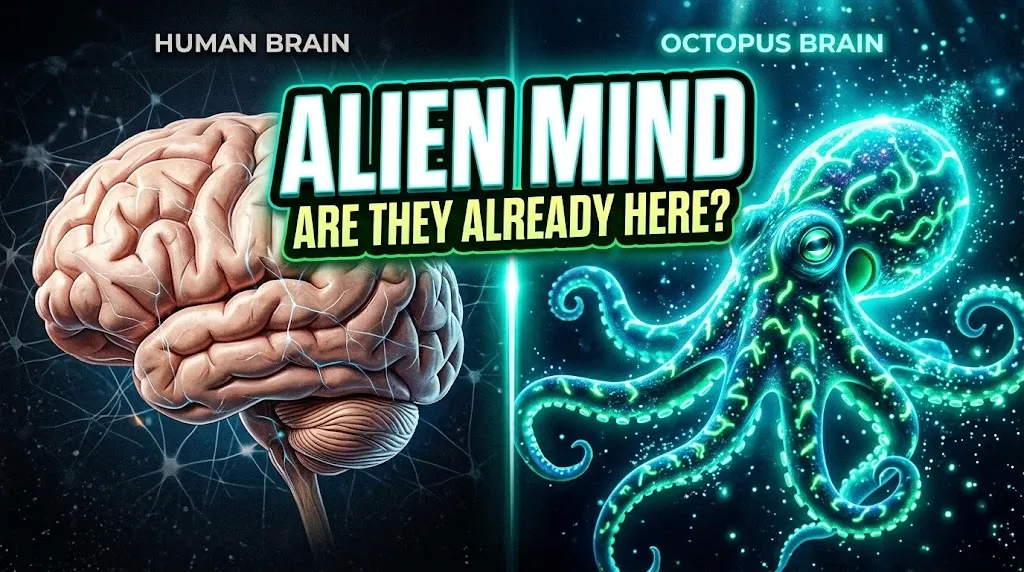
That Remarkably Bright Creature: Intelligence, Consciousness, and a Truly Alien Mind
“An octopus doesn’t just have a brain in its head; it thinks with its arms and even with its skin, a truly alien mind distributed throughout its entire body.”
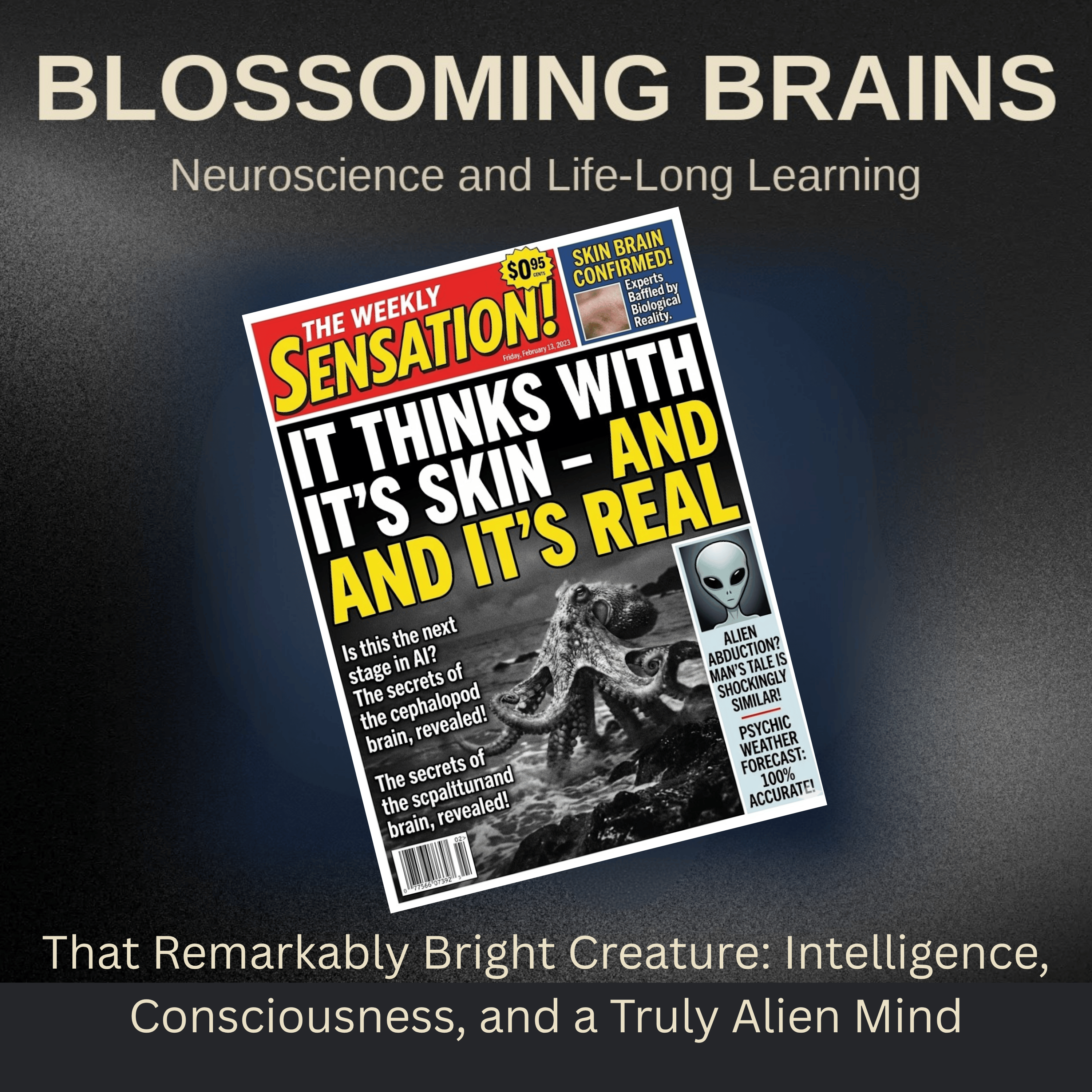
That Remarkably Bright Creature: Intelligence, Consciousness, and a Truly Alien Mind
Episode [1] · [May 4, 2026] · Blossoming Brains Podcast
Introduction:
In this episode of Blossoming Brains, Dr. Vicki Draeger explores the fascinating world of octopus intelligence and what it can teach us about learning, adaptation, and consciousness. From Inky the octopus’s famous aquarium escape to the octopus’s distributed nervous system, tool use, camouflage, and possible dreaming, this episode dives into how the octopus brain works and why cephalopods challenge everything we thought we knew about intelligence.
Listen on:
🟢 Spotify
▶️ YouTube
In this episode
The true story of Inky the octopus and what his escape reveals about octopus problem-solving.
How the octopus nervous system is distributed across its arms, not just centralized in one brain.
Why octopuses are a remarkable example of convergent evolution and animal intelligence.
How octopus skin, camouflage, and sensory abilities work together in real time.
What octopus sleep, dreaming, and behavior may reveal about animal consciousness.
Key takeaways
Octopuses have roughly 500 million neurons, and most of them are located in their arms rather than in a single central brain.
Their distributed intelligence allows them to solve problems, manipulate objects, and respond quickly to their environment in ways that look strikingly sophisticated.
Octopus camouflage is not just visual disguise; it is part of a deeply integrated sensory and neural system.
Tool use, play, and memory suggest that cephalopods are among the most cognitively complex invertebrates on Earth.
Studying the octopus brain helps scientists ask bigger questions about consciousness, learning, and what a mind can be.
Resources mentioned
Anderson, R. C., Mather, J. A., Monette, M. Q., & Zimsen, S. R. M. (2010). Octopuses (Enteroctopus dofleini) recognize individual humans. Journal of Applied Animal Welfare Science, 13(3), 261–272.
Bear, M. F., Connors, B. W., & Paradiso, M. A. (2020). Neuroscience: Exploring the brain (4th ed.). Jones & Bartlett Learning.
Dissegna, A., et al. (2023). Octopus vulgaris exhibits interindividual differences in problem-solving approach and success. Animals, 13(24), 3850.
Finn, J. K., Tregenza, T., & Norman, M. D. (2009). Defensive tool use in a coconut-carrying octopus. Current Biology, 19(23), R1069–R1070.
Godfrey-Smith, P. (2017, January 1). The mind of an octopus. Scientific American.
Hwaun, E., & McCoy, M. (2023, February 9). Octopus brains. Wu Tsai Neurosciences Institute, Stanford University.
Kandel, E. R., Schwartz, J. H., Jessell, T. M., Siegelbaum, S. A., & Hudspeth, A. J. (2013). Principles of neural science (5th ed.). McGraw-Hill.
Mayo Clinic Press. (2024). The power of neuroplasticity: How your brain adapts and grows as you age.
Naqvi, N., Shiv, B., & Bechara, A. (2006). The role of emotion in decision making: A cognitive neuroscience perspective. Current Directions in Psychological Science, 15(5), 260–264.
NPR. (2008, November 2). The story of an octopus named Otto.
Pophale, A., et al. (2023). Wake-like skin patterning and neural activity during octopus sleep. Nature, 619, 129–134.
Queensland Brain Institute. (n.d.). Action potentials and synapses.
Richter, J. N., Hochner, B., & Kuba, M. J. (2016). Pull or push? Octopuses solve a puzzle problem. PLOS ONE, 11(3), e0152048.
Squire, L. R., & Kandel, E. R. (2009). Memory: From mind to molecules (2nd ed.). Roberts & Company
The Guardian. (2016, April 13). The great escape: Inky the octopus legs it to freedom from New Zealand aquarium.
The Guardian. (2023, June 28). Octopuses changing skin pattern while asleep may show they dream, research shows.
ScienceAlert. (2025, January 15). Octopus arms are controlled by a nervous system that's like no other.
Watch on YouTube
Episode transcript: That Remarkably Bright Creature: Intelligence, Consciousness, and a Truly Alien Mind
Okay, imagine this. It’s the middle of the night at the National Aquarium of New Zealand. The building is dark and quiet. But in one of the tanks, a daring escape is underway. The lid, left just slightly ajar, is slowly pushed open. An eight‑armed contortionist about the size of a basketball silently pulls itself out and slithers across the floor, finding a drainpipe, a tiny 50‑meter‑long tube leading directly to the ocean.
By morning, all that’s left is a wet trail. The culprit was an octopus named Inky, and he was never seen again. This wasn’t a scene from a Pixar movie, though it could have been. This was a real‑life great escape, and it raises a fascinating question. How does an animal with no bones, a brain that’s more distributed than a company with remote employees, and a family tree that branched off from ours over 600 million years ago…how does it pull off such a clever feat?
Welcome to Blossoming Brains. I’m your host, Dr. Vicki Draeger. And as a mother of five and an educator who’s taught everyone from preschoolers to postgraduates, I’ve spent my life fascinated by how we learn. My journey has taken me from being named one of the state of Hawaii’s top 12 science teachers to lecturing internationally and being an award‑winning author, as well as a finalist for the United States Department of Energy’s Albert Einstein Distinguished Educator Fellowship.
And on this broadcast, together, we will explore the most incredible learning machines on the planet: our brain. But today we’re delving deep—pun intended—into the brain of the octopus. It’s a brain that challenges everything we thought we knew about brains. It is a brain so different, so utterly alien in its design, that studying it is like meeting an extraterrestrial intelligence right here on Earth.
In fact, the Martians in H. G. Wells’ science‑fiction classic War of the Worlds were described as large octopus‑like creatures, almost entirely head, with huge eyes, a V‑shaped beak‑like mouth, and two bundles of eight tentacles—so sixteen total—that served as hands. Octopuses that we know in the ocean belong to a group called cephalopods, which also includes squids and cuttlefish.
I’ve just always kind of loved that word “cephalopod” because cepha means head, and pod means foot. So a cephalopod has its head on its foot. Already pretty alien.
Now, when we think of a brain, we picture a single centralized command center in our head. It’s like the CEO in the corner office of a large technology company, making all the big decisions. It’s the brain model for all of us mammals. But the octopus used one of its eight arms to throw that blueprint right out the window.
An octopus has about 500 million neurons. That’s in the same ballpark as a dog. But here’s the mind‑bending part: only about one‑third of those neurons are in its central brain. The other two‑thirds, a staggering 300 million‑plus neurons, are distributed throughout its eight arms or tentacles.
Let’s push our technology company analogy a little bit further. Imagine the octopus’s central brain not just as a CEO, but as a visionary founder who has instilled a powerful company culture. The arms are semi‑independent departments. They don’t need constant supervision because they’re all aligned with the company’s core mission: survive and thrive.
This is why a severed arm of an octopus can still perform its basic functions. Scientists have observed that if an octopus’s arm is severed, that severed arm will continue to move, grasp things, and even try to pass food back to where its mouth should be. The arm still knows its job. The central brain simply sends out a high‑level command like, “That crab looks tasty. Let’s eat it!” and the arms figure out the details—how to coordinate, which suckers to use, how to navigate the terrain.
This is delegation on a neurological level. The company culture is so deeply ingrained that the department can continue to operate even when cut off from headquarters. No micromanagement is needed.
This is a stark contrast to our own highly centralized nervous system. If you were to sever a human arm, it would be completely inert. It has no independent processing power. It would be like a remote office that’s lost its internet connection—without a link to the central server, it’s just a building full of useless hardware.
The octopus, on the other hand, has built a resilient, decentralized network where each node can function independently. This is a brilliant evolutionary strategy for a creature that is constantly at risk of losing a limb to a predator.
This distributed intelligence also has profound implications for how the octopus experiences the world. When you reach for a coffee cup, your brain sends a series of precise commands to your arm and hand. You have a unified sense of self. You are the one reaching for the cup. But for an octopus, the experience might be different. Does it feel like it’s controlling eight separate entities, or is its sense of self distributed across its entire body?
It’s a philosophical question that scientists are still grappling with, and it challenges our very definition of consciousness.
The octopus’s skin is another marvel of its alien biology. It’s not just a passive covering; it’s an active organ. The skin is covered with millions of chromatophores, little pigment sacs that can expand and contract, allowing the octopus to change its color and even its texture in an instant. It’s a painter’s canvas.
This is the secret to their incredible camouflage, but it’s also a form of communication, and some scientists even believe it could be a form of thought. So think of the octopus’s skin as a high‑resolution, flexible display screen that is directly connected to its nervous system.
But this screen doesn’t just display images; it also senses its environment. The skin can detect light, allowing the octopus to match its surroundings with astonishing accuracy, even without input from its eyes. It’s as if the skin itself can see. This thinking skin of the octopus adds another layer to the octopus’s distributed intelligence.
The skin can react to the environment in real time, changing its appearance to match the texture of a rock or the color of a coral reef, all without conscious thought from the central brain. It’s a level of integration between mind and body that’s almost unimaginable to us. It’s like wearing a smart suit that not only changes its appearance to match your surroundings, but also feeds you information about the world around you.
So what I’m saying here is that the octopus’s ability to camouflage instantly doesn’t always require conscious thought. The octopus’s skin can adjust based on sensory input, effectively thinking with its skin as much as with its brain. It’s crazy. It’s almost like having a built‑in adaptive cloak that responds in real time to the environment—something that makes me think about Harry Potter’s cloak of invisibility.
So what we have here is this creature with a brain in each of its arms. And what does that mean in practice? It means that the octopus is a master problem‑solver.
Aquariums around the world are filled with stories of their extraordinary antics. Here’s the classic jar experiment. An octopus is presented with a tasty crab locked inside a screw‑top jar. At first the octopus prods and pulls, but soon it begins to explore the lid. Through trial and error, it figures out the twisting motion required and enjoys its meal.
And octopuses don’t just learn this; they remember it. The central brain simply sends out a high‑level command like, “That crab looks tasty. Let’s get it,” and the arms figure out the details: how to coordinate, which suckers to use, how to navigate the terrain. This is delegation on a neurological level.
Think of the octopus as a master locksmith. When faced with a locked box or a screw‑top jar with a crab inside, it doesn’t just apply brute force. It explores the lock, testing its different components. It’s as if each arm is a different key, and the octopus tries each one until it finds the one that fits. This is a far more sophisticated approach than simply trying to smash the box open. It’s a methodical, intelligent process of elimination.
But octopus intelligence goes beyond simple puzzles. They’re one of the few invertebrates known to use tools. In Indonesia, a scientist watched as veined octopuses gathered discarded coconut shell halves. They would awkwardly carry these shells around and, when they needed to hide, they would pull the two halves together to create a portable armored shelter. This isn’t just using an object; it’s planning for the future—carrying a tool that has no immediate use, but will probably be valuable later.
Octopuses also have distinct personalities. Researchers have found that some octopuses are bold and adventurous, while others are shy and cautious. Octopuses can recognize individual humans and will behave differently toward them. At one aquarium, a nice keeper would feed the octopuses, while a mean keeper would touch them with a bristly stick.
It didn’t take long for the octopuses to learn. They would approach the nice keeper with curiosity, but they would hide or even squirt water at the mean one. And they don’t just squirt water randomly. At the Sea Star Aquarium in Germany, an octopus named Otto repeatedly caused mysterious blackouts. Staff eventually discovered that Otto, apparently annoyed by the bright overhead light, had learned to shoot a precise jet of water at the bulb, short‑circuiting the entire system.
This wasn’t just a reflex. It was observing a cause‑and‑effect relationship and acting on it to change one’s environment. Think about that for a moment.
Perhaps the most hauntingly beautiful glimpse into the octopus’s mind comes when it sleeps. We used to think sleep was a simple uniform state of rest, but we now know that many animals, including us, have different sleep stages. There’s a quiet sleep, and then there’s REM, or rapid eye movement sleep, the stage where we have our most vivid dreams.
Recently, scientists discovered that octopuses have a remarkably similar two‑stage sleep cycle. During their quiet sleep, they’re pale and still. But then they enter an active sleep phase, and their eyes dart back and forth and their arms twitch. Most spectacularly, their skin erupts in a dazing, chaotic light show. They flash through patterns and colors, mimicking the textures of rock and sand, then shifting to the bright warning displays of a confrontation, then back to the camouflage of hunting.
So what’s going on here? One compelling theory is that scientists were watching octopuses dream. Just as our brains replay the events of the day during REM sleep, the octopus’s brain might be replaying its own experiences—hunting a crab, hiding from a shark, exploring a reef. Their skin, which is their primary mode of expression when awake, continues to talk while they sleep, giving us a direct visual readout of their dreaming minds. It’s a window into a subjective experience that is in every way alien to our own.
Some of you may have watched your dog sleep and suddenly its legs start moving like it’s running and you think, “He’s dreaming,” and you are right. Scientific evidence confirms that, like humans, and apparently probably octopuses, dogs experience REM—rapid eye movement—sleep, during which their brains are highly active and process daily memories. Dogs likely dream about familiar everyday activities like playing, chasing, or running. Octopuses probably dream about catching crabs and avoiding predators.
So let’s ask ourselves to begin with: why did this soft‑bodied mollusk, whose ancestors were simple, slug‑like creatures, develop an intelligence that rivals a mammal’s?
This is a beautiful example of what biologists call convergent evolution. That’s when two completely unrelated species independently evolve the same solution to a problem. Think of it like two different inventors working in separate garages who both come up with the design for a car. They started perhaps with different materials. They may have had different blueprints, but they arrived at the same destination.
So for our ancestors, intelligence helped them to hunt in packs, develop tools, create complex social structures. For the octopus, intelligence was the key to survival in a world full of predators. Without a shell for protection, the octopus had to be able to outsmart its enemies. It had to be a master of camouflage, a cunning hunter, and a brilliant escape artist. Its intelligence is not a luxury. It was a survival tool.
And this brings us to one of the most poignant mysteries of the octopus: its incredibly short lifespan. For all their intelligence, most octopuses live for only a year or two. They’re born, they grow, they learn, they solve problems, and then, shortly after reproducing, they die. Smaller species may live for as little as six months, while larger species, like the giant Pacific octopus, are an exception and can live three to five years. Still a fairly short time.
This short lifespan is a paradox that has long puzzled scientists. Why would evolution go to the trouble of building such a complex brain for a creature with such a short existence? It’s like building a supercomputer that’s only used for a single calculation. It seems like a waste of resources. But nature is rarely wasteful. There must be a reason for this short, brilliant life.
One theory is that the octopus’s rapid growth and short lifespan are an adaptation to its environment. In the ocean, life is precarious. A short life cycle allows the octopus to reproduce quickly, ensuring the survival of its species in a dangerous world. So survival of the species takes precedence over survival of the individual.
Another possibility is that the octopus’s intelligence is so energy‑intensive that it simply can’t be sustained for a long time. We know that the brain is a hungry organ—20% of a human’s energy is consumed by the brain—and the octopus has a distributed nervous system, and that would be particularly demanding. It may be that the octopus burns so brightly that it simply burns out quickly.
Whatever the reason, the octopus’s short life is a reminder that intelligence can take many forms and that a long life is not a prerequisite for a complex mind.
For a long time, octopuses were thought of as solitary, antisocial creatures. But recent research has begun to challenge this view. While they’re not social in the same way as primates or dolphins or herd animals, they do have a surprisingly complex social and emotional life. We’ve already discussed how they can recognize individual humans and react differently to them. This is a form of social intelligence. It shows that they can form memories of individuals and associate those memories with positive or negative experiences. This is not something you would expect from a simple, unthinking creature.
And what about emotions? Do octopuses have feelings? This is a difficult question to answer, as we can’t ask them how they feel, but their behavior gives us some clues. They have been observed engaging in what appears to be play, which is often associated with positive emotions in other animals. They will play with toys in their tanks and even engage in games with their keepers. Playful behavior is a hallmark of advanced intelligence.
In captivity, octopuses have been observed playing with objects like toys or even jetting water at floating balls, just for fun. Play is important because it’s a way animals experiment with their environment, sharpen skills, and engage in social interaction, even if octopuses are generally solitary creatures. This playful curiosity highlights the richness of their mental lives and challenges us to rethink the boundaries of intelligence. And of course, educators have long recognized the importance of play for a child’s early learning and development.
Speaking of play, their intelligence has captured our imagination so much that it’s even made them internet stars. You may have seen a viral video of an octopus appearing to play the piano. While it’s a wonderfully creative and fun video, it’s important to know that it was a clever digital creation. Octopuses, for all their dexterity, lack the rigid bone structure needed to press piano keys with any force. The video is a testament not to the octopus’s musical ability, but to our own fascination with their incredible minds. We want to believe that they’re capable of anything.
So now we’ve talked about the octopus’s problem‑solving skills in a lab. But another fascinating aspect of octopus cognition is their problem‑solving strategies in the wild. Unlike many animals that rely heavily on instinct, octopuses use trial and error to navigate challenges, just as they use trial and error to open up that jar that had the crab in it.
For example, when hunting crabs hiding in crevices in the wild, an octopus might try different approaches: probing, prying, even using tools like coconut shells or other discarded shells as portable shelters or weapons. Tool use was once thought to be uniquely human, or at least limited to primates and some birds. Octopuses now blow that idea wide open.
Our human experience in the world is dominated by sight and sound. But for the octopus, the world is a symphony of senses, a rich tapestry of information that’s almost unimaginable to us. We’ve already talked about their thinking skin, but their other senses are just as remarkable.
Take their sense of taste, for example. We taste with our tongues. But the octopus tastes with its arms. Each of its suckers is covered with chemoreceptors, allowing it to taste whatever it touches. Just imagine being able to taste a strawberry just by picking it up. This is the world of the octopus. It’s a world where touch and taste are one and the same—a world of intimate, immediate sensory experience.
And then there are their eyes. An octopus has two large, highly developed eyes, with one located on each side of its head, providing good vision and 360‑degree viewing capabilities. These eyes operate independently, to a large extent, and that’s called monocular vision. We humans have binocular vision, and that means we use both eyes simultaneously with overlapping fields of view, roughly 120 to 140 degrees, that the brain fuses into a single three‑dimensional image.
The octopus eye is a marvel again of convergent evolution. It’s remarkably similar to our own. The eye features a cornea, iris, large spherical lens, and a retina. Notably, they have U‑shaped horizontal pupils that provide a wide field of view. They don’t have a blind spot like we do that, of course, our brain just fills in for us, but they don’t even have that blind spot. And they are colorblind. They use their skin as photoreceptors to assist in vision as well as camouflage, but their eyes evolved completely independently of ours. It’s as if two different engineers, working on two different planets, both came up with the same design for a camera.
But the octopus’s eyes have a few tricks that ours don’t. The octopus eyes can see polarized light, an ability that’s useful for hunting in the dappled light of the ocean. It’s a subtle difference, but it’s a reminder that the octopus sees a world that is hidden from us.
The octopus’s intelligence is not just a product of its unique biology. It’s also a product of its environment. The ocean is a dangerous place, and the octopus is a soft, squishy creature with no shell to protect it. It is a tempting meal for a wide variety of predators, from sharks to seals to dolphins. In this constant high‑stakes game of hide and seek, the octopus has had to evolve a powerful intellect to survive.
This is the concept of the predator‑prey arms race. As predators become more effective at hunting, prey must become more effective at evading them. This creates a feedback loop, a constant cycle of adaptation and counter‑adaptation. The octopus, with its soft body, was at a distinct disadvantage in this arms race. It couldn’t rely on brute force or physical defenses. It had to rely on its wits, and so the octopus became a master of camouflage, a brilliant escape artist, and a cunning hunter who could see 360 degrees—everything around it.
It developed a complex nervous system that could process information quickly and react to threats in an instant. It learned to use tools to solve problems and to remember the lessons of the past. Its intelligence is not a luxury. It’s a weapon forged in the crucible of the predator‑prey arms race.
The octopus’s unique biology is not just a source of fascination for biologists. It’s also a source of inspiration for engineers. The field of soft robotics, which aims to create robots with flexible, soft bodies, is heavily influenced by the octopus. The octopus’s ability to bend, twist, and squeeze into tight spaces is a model for a new generation of robots that can navigate complex environments and interact with the world in a more gentle, natural way.
Imagine a search‑and‑rescue robot that can squeeze through the rubble of a collapsed building after an earthquake, or a surgical robot that can navigate the delicate tissues of the human body without causing damage. These are the kinds of technologies that are being inspired by the octopus. The octopus is not just a creature of the past. It’s a roadmap for the future.
Finally, the octopus’s approach to reproduction is as strange and fascinating as the rest of its biology, and it’s a process deeply intertwined with its nervous system, though perhaps not in the way you’d expect. Overall, it can be considered as tragic as the story of Romeo and Juliet.
For the male octopus, mating is a high‑stakes affair. He uses a specialized arm called a hectocotylus, which is essentially a biological multi‑tool for love. It’s used to transfer packets of sperm called spermatophores to the female. Think of it as a dedicated delivery service, but one that can be incredibly risky. Depending on the species, the male might have to get dangerously close to the larger, sometimes cannibalistic female. In a truly bizarre twist of evolution, some species have a detachable hectocotylus, which the male leaves with the female.
But in all cases, mating triggers a process called senescence for the male octopus. What happens with senescence is he starts to stop eating. He loses coordination and passes away within a few weeks due to hormonal changes.
However, the female fares no better. For the female octopus, the act of reproduction triggers a pre‑programmed, irreversible decline. After she lays her eggs, a small but powerful organ located between her eyes, the optic gland, kicks into overdrive. This gland is the octopus’s equivalent of our pituitary gland, and it acts as a biological master switch. It releases a cocktail of chemicals that completely change her behavior.
She stops hunting, loses her appetite, and dedicates herself entirely to protecting her eggs. She will guard them fiercely and gently blow currents of water over them to keep them clean and oxygenated until they hatch. This isn’t even a conscious choice. It’s a form of pre‑programmed self‑destruction, a biological imperative that ensures the next generation has a chance to survive even at the cost of her own life. As previously mentioned, the species is preserved over the individual.
Still, out of thousands of eggs laid, often between 50,000 to 200,000 or more depending on the type of octopus, only about one to two percent—just roughly a handful of baby octopuses—survive to adulthood. Most hatchlings die early due to high predation and environmental hazards.
So does the octopus use its brain power for reproduction? Well, the answer is both yes and no. It’s not a matter of conscious thought or problem‑solving, like opening a jar. Instead, the intelligence is at a deeper, more ancient level of the nervous system. The optic gland, acting on genetic and environmental cues, orchestrates this entire complex process without any input from the octopus’s thinking mind. It’s a powerful example of how the nervous system can execute incredibly complex, life‑altering commands that are completely instinctual. The brain isn’t solving a puzzle. It’s running a fatal but vital biological program.
The octopus, with its alien intelligence, forces us to confront some of the most fundamental questions of philosophy. What is a mind? What is consciousness? What is the nature of the self? These are questions that have been debated by philosophers for centuries, but the octopus gives them a new urgency and a new perspective.
Our own human‑centric view of the mind is that it is a product of the brain—a centralized, unified entity that is separate from the body. But the octopus challenges this view. Its mind is not confined to its brain. It’s distributed throughout its body. Its intelligence is not just a matter of abstract thought. It’s embodied, enacted, and lived. The octopus is a thinking, feeling, sensing being, and its mind is a product of its entire organism.
This has profound implications for how we see ourselves and our place in the world. It reminds us that our own human experience is not the only one. There are other minds, other consciousnesses, and they are as valid and as real as our own. The octopus may act as a mirror, reflecting back to us our own assumptions and prejudices, and in doing so, it opens up a new world of possibilities, a new way of thinking about what it means to be a mind in a world of minds. We will be discussing consciousness in some upcoming episodes.
So here is my call to action for you this week. The next time you encounter an animal—whether it’s a spider in your garden, a crow on a wire, or a fish in a tank—take a moment to pause. Look past the simple labels of “pest” or “pet” and wonder about the mind within. What is this world like? How does it solve the problems of its life? What kind of intelligence is at work?
Then you may wonder about its evolutionary journey or consider the divine Creator who engineered this amazing creature. Don’t forget to share your stories and thoughts with us on our social media channels. You can find references for today’s podcast at vickidraeger.com.
Now, until next week, thank you for joining me on this episode of Blossoming Brains, and don’t forget to keep learning, keep growing, and keep blossoming.
Thank you.
About the host
Dr. Vicki Draeger is a science educator, author, and mother of five whose work focuses on lifelong learning, neuroscience, and how the brain changes at every age. Named one of Hawaii’s top science teachers and a finalist for the U.S. Department of Energy’s Albert Einstein Distinguished Educator Fellowship, she now hosts Blossoming Brains to explore how minds—from human children to octopuses—learn, adapt, and thrive.