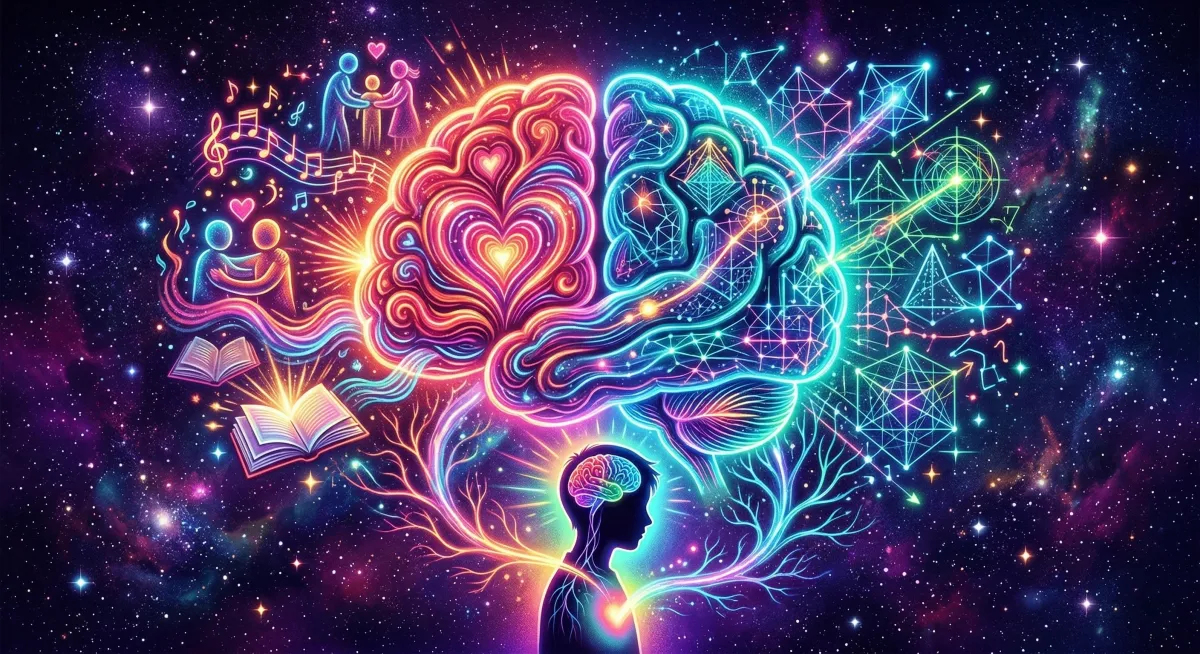
A Guided Tour of the Brain: Neuroplasticity, Memory, and How Your Mind Adapts
“Every time you learn something new, you are physically reshaping your brain.” — Dr. Vicki Draeger
A Guided Tour of the Brain: Neuroplasticity and Lifelong Learning
Episode [6] · [May 23, 2026] · Blossoming Brains Podcast
Introduction:
Your brain is not fixed — it’s constantly changing and adapting throughout your life. In this episode of Blossoming Brains, Dr. Vicki Draeger takes listeners on an engaging tour through the architecture of the brain while explaining how memory, emotions, movement, and lifelong learning shape who we become.
Using vivid analogies and approachable neuroscience, this episode explores the remarkable systems working inside your head every moment of your life — and why understanding your brain may be one of the most important tools for lifelong learning.

Listen on:
🟢 Spotify
▶️ YouTube
In this episode
Why the brain uses 20% of your body’s energy
How the frontal lobe acts like your brain’s CEO
Why music and emotions trigger vivid memories
How the cerebellum automates practiced skills
The role of the hippocampus and amygdala in memory
Why neuroplasticity changes what we know about aging and learning
Key takeaways
Your brain constantly rewires itself through experience
Different brain regions specialize in different functions
Emotional experiences are easier to remember because of the amygdala
Practice physically strengthens neural pathways
Lifelong learning supports brain flexibility and resilience
Small daily challenges help maintain cognitive health
Resources mentioned
Bear, M.F., Connors, B.W., & Paradiso, M.A. (2020). Neuroscience: Exploring the Brain (4th ed.). Jones & Bartlett Learning.
Cleveland Clinic. (2025). Brain: Parts, Function, How It Works & Conditions. https://my.clevelandclinic.org/health/body/22638-brain
Dana Foundation. Neurotransmission: The Synapse. https://dana.org/resources/neurotransmission-the-synapse/
Harvard Health Publishing. (2022). 12 ways to keep your brain young. https://www.health.harvard.edu/mind-and-mood/12-ways-to-keep-your-brain-young
Johns Hopkins Medicine. Brain Anatomy and How the Brain Works. https://www.hopkinsmedicine.org/health/conditions-and-diseases/anatomy-of-the-brain
Kandel, E.R., Schwartz, J.H., Jessell, T.M., Siegelbaum, S.A., & Hudspeth, A.J. (2013). Principles of Neural Science (5th ed.). McGraw-Hill.
Marzola, P., et al. (2023). Exploring the Role of Neuroplasticity in Development, Aging, and Disease. Frontiers in Neuroscience. https://pmc.ncbi.nlm.nih.gov/articles/PMC10741468/
Mayo Clinic. (2024). 8 brain health tips for a healthier you. https://www.mayoclinic.org/healthy-lifestyle/healthy-aging/in-depth/brain-health-tips/art-20555198
Mayo Clinic Press. (2024). The power of neuroplasticity: How your brain adapts and grows as you age. https://mcpress.mayoclinic.org/healthy-aging/the-power-of-neuroplasticity-how-your-brain-adapts-and-grows-as-you-age/
Naqvi, N., Shiv, B., & Bechara, A. (2006). The role of emotion in decision making: A cognitive neuroscience perspective. Current Directions in Psychological Science, 15(5), 260–264.
National Institute of Neurological Disorders and Stroke (NINDS). (2025). Brain Basics: Know Your Brain. https://www.ninds.nih.gov/health-information/public-education/brain-basics/brain-basics-know-your-brain
Queensland Brain Institute. Action potentials and synapses. https://qbi.uq.edu.au/brain-basics/brain/brain-physiology/action-potentials-and-synapses
Squire, L.R., & Kandel, E.R. (2009). Memory: From Mind to Molecules (2nd ed.). Roberts & Company Publishers.
Watch on YouTube
Episode transcript
Note: This summary was created from the episode transcript and highlights the main topics discussed.
In this episode of Blossoming Brains, Dr. Vicki Draeger serves as a guide through the remarkable landscape of the human brain, helping listeners understand how different regions work together to shape our thoughts, emotions, memories, and behaviors.
Using the memorable analogy of the brain as a bustling city, Dr. Draeger explores the major structures of the brain, including the frontal lobe, parietal lobe, temporal lobes, occipital lobe, cerebellum, brainstem, hypothalamus, hippocampus, and amygdala. Along the way, she explains how these regions influence everything from decision-making and language to balance, vision, memory, and emotional responses.
Listeners will discover fascinating facts about the brain's immense complexity, including its 86 billion neurons, its extraordinary energy demands, and the specialized functions of different brain regions. The episode also examines well-known neurological cases, language centers such as Broca’s and Wernicke’s areas, and the powerful relationship between memory and emotion.
Most importantly, Dr. Draeger introduces one of the most hopeful discoveries in modern neuroscience: neuroplasticity. Contrary to the long-held belief that the brain becomes fixed after childhood, research now shows that the brain continues to adapt and reorganize itself throughout life. Learning new skills, exercising, maintaining social connections, getting quality sleep, and staying intellectually curious can all contribute to building new neural connections and supporting lifelong brain health.
This episode provides a foundation for future discussions on neuroscience while encouraging listeners to become active participants in shaping their own cognitive health through lifelong learning and curiosity.
About the host
Dr. Vicki Draeger is a science educator, author, and mother of five whose work focuses on lifelong learning, neuroscience, and how the brain changes at every age. Named one of Hawaii’s top science teachers and a finalist for the U.S. Department of Energy’s Albert Einstein Distinguished Educator Fellowship, she now hosts Blossoming Brains to explore how minds—from human children to octopuses—learn, adapt, and thrive.